Jobs To Be Done: Journeys and Personas
Executive Summary: I led a project that mapped an end-to-end customer journey for 6 core personas by conducting 50+ interviews across internal and external groups.
I distilled complex data into a clear Jobs-to-be-Done framework, providing visibility and alignment across teams, departments, and leadership, ultimately influencing roadmaps and product decisions.
Why did I do this study? What is the problem I’m trying to solve with this study?
As a Researcher, you spend a lot of time being a natural silo-breaker through the time you spend learning from people in all orgs within a company. I was the first UXR hire for a few companies throughout my career. I’ve leaned on Customer Journeys and Personas to help me create alignment on our customer needs, find barriers to customer delight, and note opportunity gaps to improve the customer UX.
How am I going to do this?
For this project, I had one core success criteria deciding how I would approach this:
It can be shown to anyone within the company and they will quickly and easily understand what they are looking at: an end-to-end customer journey with all six core personas represented.
I wanted this to be in an easy-to-understand, common language that everyone could understand and anchor alignment to. To assure this, I used the Jobs To Be Done framework by Dr. Clayton Christensen.
“A ‘job to be done’ is a problem or opportunity that somebody is trying to solve. We call it a ‘job’ because it needs to be done, and we hire people or products to get jobs done...people don’t want products—they want progress in their lives.”
TL;DR: People don’t buy things, they hire things to get a job done.
Through framing everything through this common lens of JTBD by all key personas along the customer journey, I focus on solving real customer problems rather than chasing feature trends.
Instead of asking, "What features should we add?" I ask, "What is preventing you from getting this job done better?"
This leads to more meaningful innovations that customers actually value and are willing to pay for.
Free Professional Advice: Never ask your participants any predict-the-future type of questions. People can’t predict the future, therefore people can’t accurately anticipate future needs, behaviors, and attitudes.
By asking JTBD questions rooted in past behavior, you get actionable and useful data based on real-world patterns.
How did the study go? How did the deliverables turn out?
Great, and Great. Thank you for asking.
Through 50+ interviews I captured enough insight to fully represent:
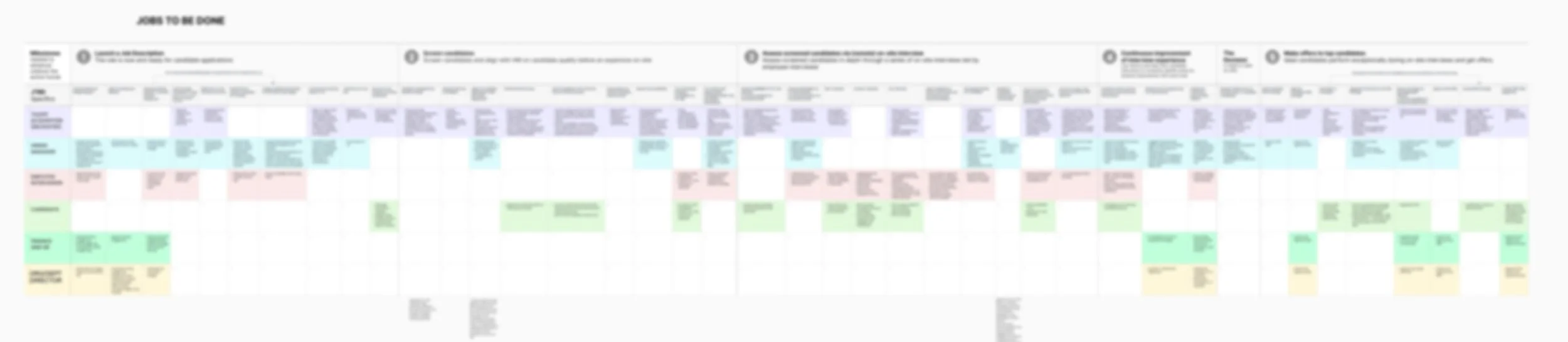
A fully broken down, universal end-to-end experience split into milestone JTBD and sub-core JTBD at each step of the Customer Journey.
Persona cards for six core personas that are one page and can be printed on standard paper. Each card includes where they are active along the journey, which steps they are leading, and what specific JTBD do they have at each specific part of involvement.
The end result was a set of comprehensive, self-explanatory deliverables of the JTBD Journey and each JTBD Persona. They could be sent to anyone in the company and the data is actionable for all organizations.
Blurry versions of the full end-to-end Journey along with a sample Persona card are below.
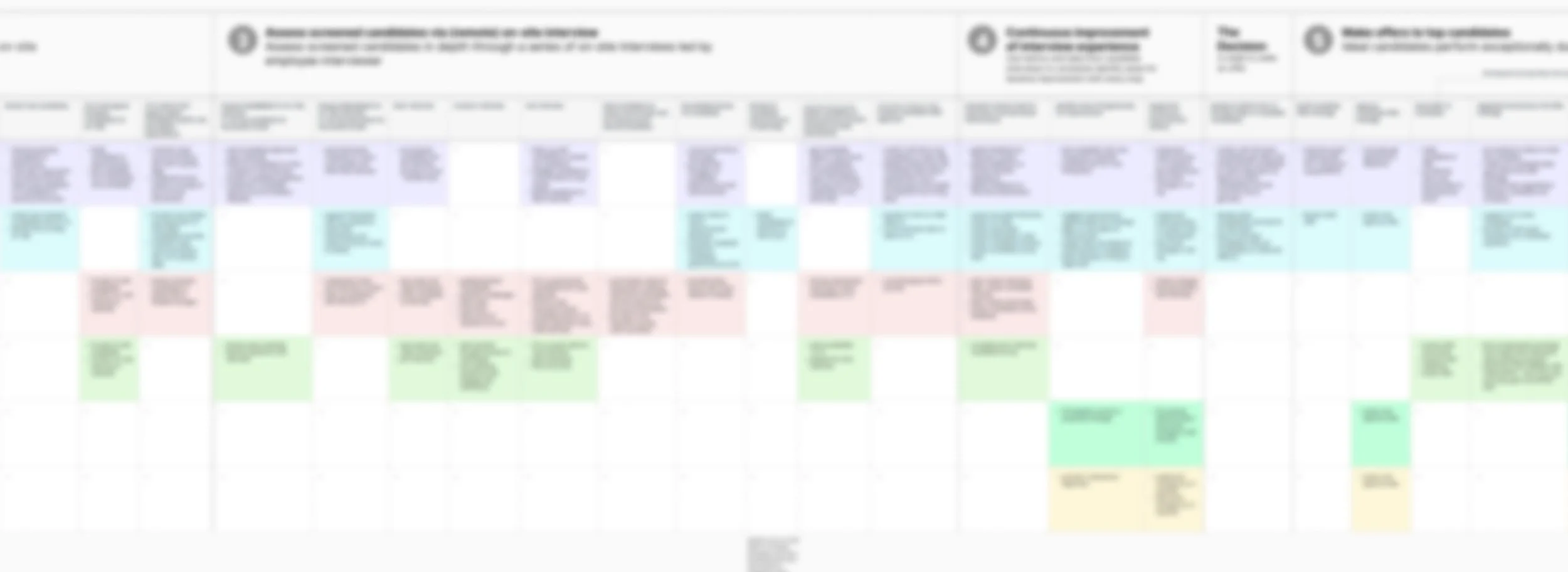
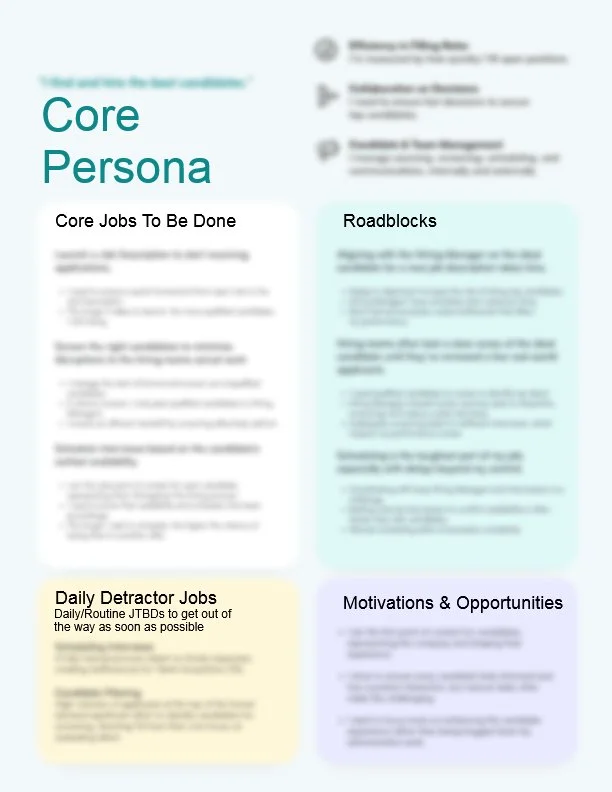
These artifacts influenced roadmaps, guided product decisions, and unveiled opportunity gaps to expand our core value prop in both directions.
The common and easily-understood JTBD language worked especially well for async alignment in a remote workplace.
Conclusions and Reflections
How did your research help both your direct teams and the wider company? What was the business impact?
The company now had a full end-to-end view of our entire customer journey. They can see exactly what jobs each of our six core personas need to hire for and when they need to hire.
This artifact got a lot of people on the same page of what is currently happening, where product led growth opportunities are, and how we can expand to better serve our customer base.
“I never realized how much of our work was happening outside of the product.”
It showed the company that we were only in a very small portion of the customer journey and we had sustaining, disruptive innovation opportunties on both sides of our offering.
This started a project that led to an idea for a new 0-1 product that got universal board of investors’ approval and excitement.
What did you, the Researcher learn from this whole thing?
I learned how to embrace AI as a Research Assistant.
As the first UXR hire and sole UXR for the entire company, this was a lot of work for one person. I supported other projects during this. I also gained an incredible amount of content from these interviews.
In this project, I learned how AI can help my workflow while still allowing me to maintain accountability for the integrity of the study results. I played to the strengths of LLM’s to use AI for help with pattern recognition and report editing.
My two top prompts I used were:
Please help me synthesize my unorganized notes attached into a first pass of core takeaways/patterns, keeping in mind that the top two questions that this study tried to answer were [Q1] and [Q2]. Remember to frame along the lines of Jobs To Be Done framework as that is what I am using for this study.
By the time I entered this prompt, I already had my own first pass at results analysis and insights synthesis. This step helped me compare and contrast my findings, as well as get a first pass a document structure for the report.Please help me condense my entire research results report attached into a single-page newsletter to send out to the entire company. My audience is [company profile] and please be sure to emphasize [top level insight that sums up entire study] as the key insight that people learn from this newsletter.
Knowing that I have help condensing long reports gave me new ways of writing research reports that are more friendly to how my mind works. AI helped as a force multiplier. I was able to get valuable insights out faster and to a wider stakeholders audience outside my immediate organization.